
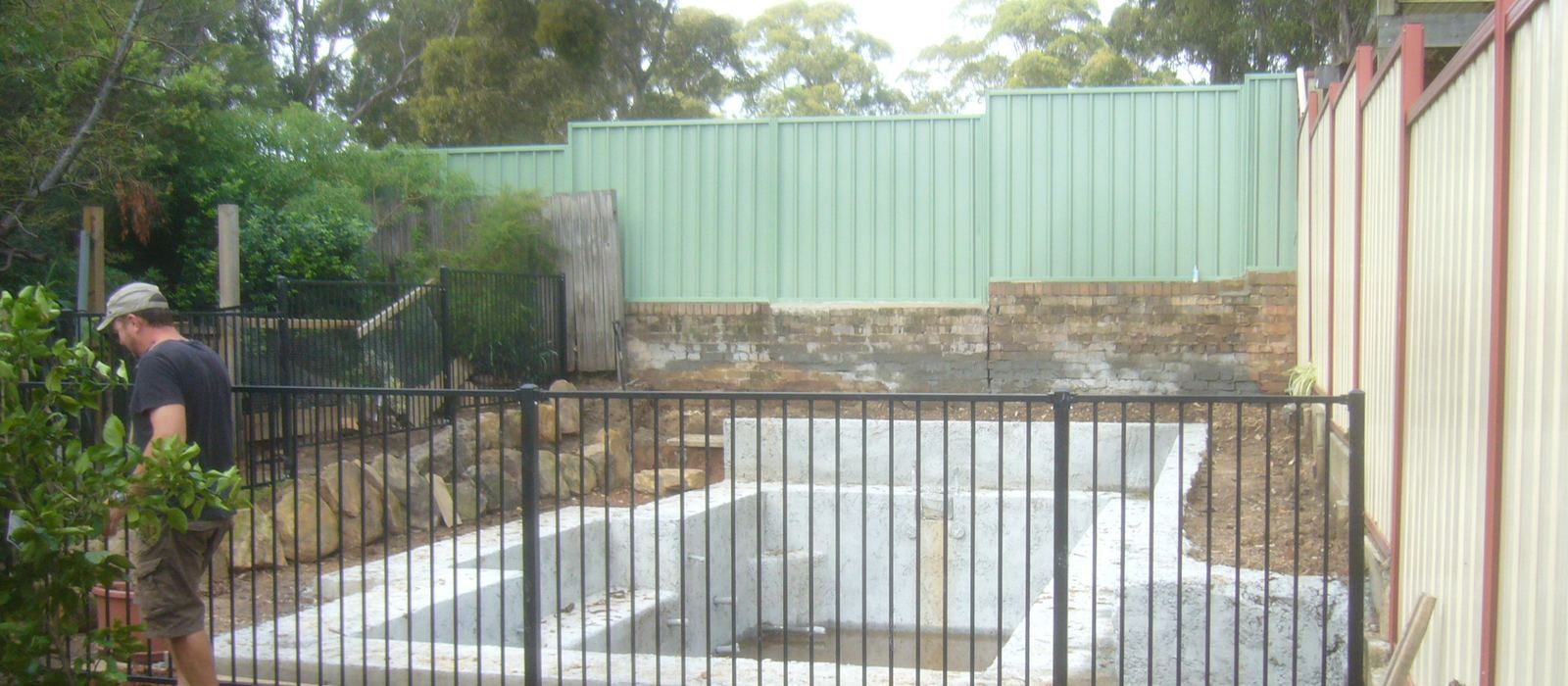
NSW pool fencing rules, explained
What the law requires, what inspectors check, and how to avoid the common reasons a pool barrier fails. Written for Sydney homeowners by a licensed fencer, checked against current NSW Government sources.
Last reviewed: 27 September 2026 · Sources
The law and the standards
Pool barriers in NSW are governed by the Swimming Pools Act 1992 and the Swimming Pools Regulation 2018. The Act requires the owner of any premises with a swimming pool to keep it surrounded at all times by a child-resistant barrier that separates the pool from the house and from any adjoining place, and that is designed, constructed, installed and maintained to the standards prescribed by the Regulation.
The prescribed technical standard is AS 1926.1 – Swimming pool safety, Part 1: Safety barriers for swimming pools. The Building Code of Australia also applies to new pools. The Act covers any structure or vessel capable of holding more than 300 mm of water and used for swimming, wading or paddling – so it includes spas and portable or inflatable pools, not just in-ground pools. In a strata or community scheme, the owners corporation is responsible for common-property pools.
How to read the rest of this page: items marked Legal requirement come from the Act, Regulation or the NSW Government's published requirements. Items marked Standard are technical details from AS 1926.1. Items marked Good practice are our recommendations from installing pool fencing. Anything about your specific property needs professional assessment.
Which standard applies to your pool
Legal requirement NSW recognises three versions of the standard depending on when the pool was built:
| Pool constructed | Standard that may apply |
|---|---|
| Before 30 August 2008 | AS 1926-1986 Fences and gates for private swimming pools |
| 1 September 2008 – 30 April 2013 | AS 1926.1-2007 Safety barriers for swimming pools |
| After 1 May 2013 | AS 1926.1-2012 Safety barriers for swimming pools |
The important exception: if the barrier is modified, altered or rebuilt – and the NSW Government notes this can include house and yard renovations – the current Act, Regulation and AS 1926.1-2012 apply and previous exemptions cease. In practice, any new fence we install around an existing pool is built to AS 1926.1-2012.
Professional assessment If you are not sure when your pool was built or whether earlier work changed the barrier, ask your council or a registered certifier before deciding what to fix. The NSW Swimming Pool Register publishes a checklist for each standard.
Fence height and boundary barriers
- Legal requirement A pool fence must be at least 1.2 m high, measured from the finished ground level on the outside of the barrier.
- Legal requirement Where a boundary fence forms part of the pool barrier, that fence must be 1.8 m high.
- Standard Height is measured on the approach side – the side a child would come from. Garden beds, paving, decking or a retaining wall that raise the outside ground level reduce the effective height.
- Good practice Build a little above the minimum. A 1.2 m panel on ground that later gets mulched or paved can easily end up under 1.2 m.
Many Sydney pools use the Colorbond side or rear boundary fence as one side of the barrier. That is allowed, but the boundary fence then has to meet the 1.8 m rule and the non-climbable zone applies on the pool side – the horizontal rails of some fences are a common failure point. Our sheet extensions are often used to bring a 1.5 m boundary fence up to height, and our Colorbond fences have no exposed horizontal rails a child can stand on when the sheets face the pool.
Gaps and openings
- Legal requirement The gap between the bottom of the fence and finished ground must not exceed 100 mm.
- Legal requirement Gaps between vertical bars must not exceed 100 mm. Our flat top and rod top pool panels use 70 mm spacing.
- Legal requirement Horizontal climbable members must be at least 900 mm apart.
- Legal requirement Perforated or mesh barriers 1.2 m high must have openings no greater than 13 mm; 1.8 m mesh barriers with openings over 13 mm must not exceed 100 mm.
- Standard Gaps are tested with a rigid object; uneven ground under a panel counts. Where the ground falls away under a fence, the gap is measured at the largest point.
Non-climbable zones
Legal requirement Pool owners must maintain a 900 mm non-climbable zone around the barrier. It is measured as an arc from the top of the fence towards the ground on the outside, and it also extends 300 mm inside the pool area. Nothing a child could use as a foothold or handhold may be in these zones:
- trees, shrubs and branches;
- barbecues, pot plants, furniture, toys, ladders, chairs and bins;
- retaining walls, garden edging, taps, meter boxes and fence rails;
- horizontal members on the fence itself, unless they are at least 900 mm apart.
Good practice Walk the outside of your barrier once a season. The zone is easy to build correctly and easy to lose later to a new garden bed, a wheelie bin or a growing hedge.
Gates
Gates are the single most common reason barriers fail. Legal requirement A pool gate must:
- never be propped open, and always be kept shut;
- swing outwards, away from the pool – a gate that swings in must be re-hung;
- self-close from any open position without being pushed;
- self-latch automatically when it closes.
Standard AS 1926.1-2012 sets out the latch requirements in detail, including that the latch release is positioned at least 1500 mm above ground or is otherwise shielded so a young child cannot reach and operate it, and that the gate cannot be opened by lifting or reaching through. Good practice Test the gate from a few centimetres open, half open and fully open – it must latch every time. Lubricate hinges and latch, and check the hinge tension after the first month; our pool gates use adjustable self-closing hinges for this reason.
Double gates, sliding gates and gates that open onto the pool from a garage or shed have additional considerations under the standard – get them assessed.
Doors, windows and house walls
Legal requirement Older pools often relied on child-resistant doors or windows from the house as part of the barrier. The NSW Government states this is no longer allowed. A wall of the house can still form part of the barrier under section 19 of the Act if there is no door or opening in it that gives access to the pool (windows are subject to the standard's opening limits), but a door opening into the pool area does not comply.
Professional assessment If your back door opens straight onto the pool, the usual fix is a separate fence isolating the pool from the house – we quote this regularly. Get the layout assessed before ordering.
Retaining walls, decks and changes in ground level
Standard Barrier height is measured from the finished ground level on the outside. A retaining wall, raised garden bed, deck or even a mounded lawn on the outside of the fence reduces the effective height and may sit inside the non-climbable zone. Conversely, a fence on top of a retaining wall that drops away on the outside can comply with a shorter panel, subject to the standard's rules about the wall surface being non-climbable.
Good practice Tell us about any level change when you enquire – it changes the design. See retaining walls under fences.
Registration, inspections and certificates
- Legal requirement Every pool and spa (including portable pools over 300 mm deep) must be registered on the NSW Swimming Pool Register. Registration is against the property address and is free online; your council can do it for a small fee. Registration does not mean the pool is compliant.
- Legal requirement A CPR sign must be displayed near the pool, in good condition and readable from 3 m. Signs issued from 1 September 2019 are required for new pools and for barriers substantially altered or rebuilt.
- Legal requirement Councils run barrier inspection programs and inspect pools at tourist accommodation and moveable dwelling sites every three years. Councils and registered swimming pool inspectors (private certifiers) inspect on request and issue a certificate of compliance (valid three years) or a certificate of non-compliance.
- Legal requirement Selling: the contract must include the registration certificate and one of: an occupation certificate issued in the last three years, a certificate of compliance, or a certificate of non-compliance. With a non-compliance certificate the buyer has 90 days after settlement to rectify and obtain compliance (unless the pool is deemed a significant risk). Renting: the tenant must be given a certificate of compliance or occupation certificate; a non-compliance certificate cannot be used. Strata and community schemes with more than two lots are exempt from these sale and lease provisions.
- Legal requirement New pools: use a licensed builder, appoint a principal certifier, install temporary child-resistant fencing during construction, have the permanent fence inspected, and do not use the pool until an occupation certificate is issued.
Some certifiers can carry out minor repairs (up to $1,000) to enable a certificate, if they hold the relevant licence; you are free to use your own fencer.
Why barriers fail inspection
Good practice From the jobs we see, the usual reasons are:
- Gate does not self-close or self-latch from every position, or swings inward.
- Climbable objects in the 900 mm zone – pot plants, furniture, a barbecue, a hedge, a bin.
- Boundary fence used as a barrier is under 1.8 m or has climbable horizontal rails on the pool side.
- Gap under the fence over 100 mm after landscaping, erosion or a new path.
- Effective height under 1.2 m because the outside ground has been raised.
- A door or window from the house opening into the pool area.
- Loose panels, missing screws, a bent gate or worn hinges – maintenance is a legal duty too.
- No CPR sign, or one that is faded and unreadable.
Before you order a pool fence
- Find out when the pool was built and whether the barrier has been altered since.
- Check the property on the Swimming Pool Register – is it registered, and is there a current certificate?
- Decide which sides of the barrier will be boundary fence (1.8 m rule) and which will be pool panels (1.2 m minimum).
- Note every door and window that faces the pool area, and every level change, deck or retaining wall.
- Walk the outside of the proposed fence line and clear or plan to clear the 900 mm zone.
- Decide where the gate goes: it needs room to swing outward and a clear approach.
- Book the inspection before you need it – especially if selling or leasing.
When you request a pool fencing quote, include photos of the pool surrounds and boundary fences. We build to AS 1926.1-2012 and point out anything we can see that would fail; the compliance certificate itself comes from your council or a registered certifier.
Questions we are asked most
Does my Colorbond boundary fence count as a pool fence?
My pool was built in 1995. Do the 2012 rules apply?
How high must a pool fence be?
Can my back door open into the pool area?
Which way must the gate open?
Do I need to register my pool?
Do I need a certificate to sell or rent?
Will installing your fence make my pool compliant?
Sources and further reading
This page was checked against the following sources on 27 September 2026. Legislation and government guidance change; if anything here conflicts with a current official source, the official source prevails.
- NSW Government – Owning a pool or spa: your obligations (updated 16 March 2026)
- Swimming Pools Act 1992 No 49 (NSW legislation, current)
- Swimming Pools Regulation 2018 (NSW legislation, current)
- NSW Swimming Pool Register (registration, checklists, certificates)
- NSW Swimming Pool Register – user guide for owners (Building Commission NSW, March 2026)
- NSW Swimming Pool Register – pool inspections and finding a certifier
- Building Certifiers Public Register (NSW Fair Trading) – search 'Swimming Pool Inspector'
- AS 1926.1-2012 Swimming pool safety – Part 1: Safety barriers for swimming pools (Standards Australia, purchase required)
Published 2026-09-27. Fencing Sydney is a licensed fencing contractor (NSW Licence 269038C), not a registered swimming pool inspector. Portable and inflatable pools are subject to the same barrier requirements; spa pools may use a lockable child-resistant cover instead of a fence in some circumstances – check with your council.